
Viodi View Menu
| Previous
Issue
|
| Viodi
View Subscribe |
| Viodi Forums |
| Multimedia
Search |
| Viodi Workshops |
| Industry |
| About Viodi |
Interested in Sponsoring the Viodi View? Send an email to: [email protected]
Please forward this free publication to anyone you know who is involved in some way with independent telephone companies.
Mission of the Viodi View:
In this on-line publication, we share our analysis, opinions and direction on the interactive television news and views that we believe will be of interest and use to our friends associated directly or indirectly with independent telephone companies. For more information as to the various ways Viodi works with independent telephone companies, please go to http://www.viodi.com/alliance/
Disclaimer:
The Viodi View [Viodi, LLC] and its associates used their best efforts in collecting and preparing the information published herein. However, the Viodi View [Viodi, LLC] does not assume, and hereby disclaims, any and all liability for any loss or damage caused by errors or omissions, whether such errors or omissions resulted from negligence, accident, or other causes.
All displayed trademarks, logos and service marks are
the property of their respective owners. © 2005Viodi,
LLC. All Rights Reserved.
5255 Stevens Creek, #127 Santa Clara, CA 95051
Viodi View Newsletter - November 1st, 2006

Click here to learn about Entone
By Ken Pyle, ken.pyle at viodi.com, Managing Editor, Viodi View
- Encoding Breakthrough
- Frame Free – Low Cost, High Definition Content
- Get Veeked – Driving Wireless Photos and Videos to the Web
- We Be Jammin’ with 3Jam – Creating Text Messaging Demand
- M2B World – Yet Another TV Over Internet Solution
- Video Over Internet Middleware Solutions
One of the most exciting things at last week’s Digital Hollywood conference, at least from an independent telco perspective, is the encoding solution from the Kula Media Group. This solution was developed by a couple of young men who grew up in New Braunfels, Texas, home to Guadalupe Valley Telephone. The development was bankrolled by one of the founders of Rush Enterprises.
The Kula solution promises to provide either a 30% improvement in quality or a 30% reduction in bandwidth for an equivalent level of quality. From the demonstration I saw, it seems to work well. It relies on parallel processing in multi-core processors to achieve this improvement. It works on multiple types of codecs, including both MPEG-2 and MPEG-4.
Upshot for Telcos
If this is as good as it purports to be, it could revolutionize the business and make high definition over DSL a reality.
Frame Free – Low Cost, High Definition Content
The Frame Free product is an amazing way to produce and display high definition content. This codec is based on 3D graphics, much like a video game. Frame Free has developed software that allows images to be animated into motion graphics. This offers great potential as a way of reducing costs of high definition content production, as anyone with a regular resolution camera can create videos based on photos.
The Frame Free product offers a timeline editing function that allows audio to be rendered faster than real-time. The file size, when using Frame Free’s proprietary player, is less than 1/25 of an equivalent size Windows Media High Definition file. Their proprietary player has been integrated with Qualcomm’s BREW, wireless broadband service. Frame Free has different versions of its product, some which will also output other output files, including AVI and Windows Media. The base product starts at $50 per month.
Upshot for Telcos
This could be an interesting tool for producing low cost, high quality commercials.
Get Veeked – Driving Wireless Photos and Videos to the Web
Veeker’s product makes simplifies the production of user generated content via the cellular phone. Their product allows photos and videos produced from cellular phones to be transmitted to a personal web site, which automatically gets updated. The set up is real simple, as a user just has to email the photo or video to [email protected]. To retrieve the photos, one simply has to enter their phone number. It automatically creates a web site for that person that can be shared with their friends.
Upshot for Telcos
This offering makes for a much stickier web site, as well as drives cellular message traffic by giving people a reason to email from their phones. Veeker will private label this service.
We Be Jammin’ with 3Jam – Creating Text Messaging Demand
3Jam gives people the ability to send text messages to multiple people at one time, much like email already allows. It allows “reply all” to a text message, so that the same message can be sent to multiple people and, as importantly, a message thread can be woven. Applications suggested by 3Jam for this service include sport group coordination (e.g. games been postponed message), real-time event coordination (let’s meet at the mall), trivia games, viral marketing messages and public safety (e.g, coordinate emergency personnel). 500 people per day are being added to the 3Jam network since its September 25th, 2006 launch.
Upshot for Telcos
This service promises to drive more text messaging traffic, which should mean more revenue for the operator. The impact on the operator is minimal as they just have to provide a short code. Long-term, 3Jam is looking at revenue share from the operators as a revenue source.
M2B World – Yet Another TV Over Internet Solution
This is another video over the Internet solution, similar to previously reported efforts from companies like Neulion. What makes this company unique is that apparently it has been in operation for several years in Singapore. They have apparently developed an entire solution that includes set-top and back-office, which provides a cable television-like experience over broadband.
Upshot for Telcos
This could offer a white label alternative to the traditional IPTV approach. M2B World and others should look for carriers and others to help them market their service, as the marketing for these Video Vonages will probably be a bigger challenge than the technology.
Video Over Internet Middleware Solutions
Several of the booths at Digital Hollywood were occupied by companies that I liken to middleware for video over the Internet. A couple of these companies, like Vitalstream and Narrowstep provide all of the functions necessary for a content producer to encode, ingest, stream, splice in ads and report on video and/or audio. These companies essentially allow a content producer/owner to be a distributor and have a direct relationship with the customer, bypassing the cable or telco operator which has traditionally had the end consumer relationship.
Narrowstep is interesting, as they have worked with corporate and specialty web sites, such as HorseTV to deliver video to niche audiences. In England, they have integrated with the Amino set-top to allow television over the Internet, offering the potential of a competing service to a carrier’s IPTV service. The cost of the Narrowstep service is approximately $15k upfront and $4k per month, along with the cost of bandwidth (which they estimate to be between 45 to 85 cents per gigabyte.
Vitalstream is similar to Narrowstream in that it provides content ingest, distribution, advertising and reporting solution. It also supports pay per view, subscription and free models. Vitalstream also provides advertising aggregation services and is a big advertising network to help their affiliates monetize their content, as necessary. Some of their big name clients include ABC Radio and the Wall Street Journal.
Others in this space include Roo Networks and Entriq. Entriq is interesting as they provide the content security, authentication and reporting for Intel’s Vive platform.
Upshot for Telcos
There may be opportunities to work with these providers. First, they require bandwidth, which an independent telco can provide. Conceivably, they could private label their service for an independent telco to use.
[Note, there will be more tidbits from the Digital Hollywood conference in the next issue]
Viodi View Subscribe


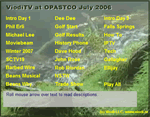 ViodiTV DVD More Info

The Video Business Case for Independent Telcos – The Report
Viodi’s report, Video Business Case provides results to a survey of independent telcos and their business case for video. Most of the telcos that responded to the survey have figured out a way to deploy video services. This survey provides insight from the independent telcos as well as several of their Engineering firms.

Local Content Workshop
November. 16, 2006