
Viodi View Menu
| Previous
Issue
|
| Viodi
View Subscribe |
| Viodi Forums |
| Multimedia
Search |
| Viodi Workshops |
| Industry |
| About Viodi |
Interested in Sponsoring the Viodi View? Send an email to: [email protected]
Please forward this free publication to anyone you know who is involved in some way with independent telephone companies.
Mission of the Viodi View:
In this on-line publication, we share our analysis, opinions and direction on the interactive television news and views that we believe will be of interest and use to our friends associated directly or indirectly with independent telephone companies. For more information as to the various ways Viodi works with independent telephone companies, please go to http://www.viodi.com/alliance/
Disclaimer:
The Viodi View [Viodi, LLC] and its associates used their best efforts in collecting and preparing the information published herein. However, the Viodi View [Viodi, LLC] does not assume, and hereby disclaims, any and all liability for any loss or damage caused by errors or omissions, whether such errors or omissions resulted from negligence, accident, or other causes.
All displayed trademarks, logos and service marks are
the property of their respective owners. © 2005Viodi,
LLC. All Rights Reserved.
5255 Stevens Creek, #127 Santa Clara, CA 95051
Viodi View Newsletter - October 4th, 2006

Click here to learn more about the Technology of Local Content Workshop
By Ken Pyle, [email protected], Managing Editor, Viodi View
- Agenda Set for Technology Local Content – Tut & Entone to Sponsor
- Fair Weathered Friends
- Phildelphia’s Wireless Initiative – An Opportunity for Comcast?
- Should Rules for Rural Wireless Auctions Be Different
- Will the Real “Mobile WiMAX” Please Stand Up! - by Alan J. Weissberger
- Wireless Gadgets & Gizmos
- Apple’s iTV or Google TV – A Trojan Horse for Something Bigger?
- NTCA Fall Conference & Key Employee Conference Take-Aways
- A Peer to Peer Conference with Peers
- In Memoriam: Wendell Bailey
- Run for Roger
- Oops – correction to last issue
- The Korner - Krazy or Insane
As I sit here in an undersized airplane seat struggling to get a brand new D.C to A.C inverter working so I can eek every minute out of another Sunday afternoon flight, I have to wonder; what happened to the mantra of TQM (Total Quality Management) that we heard so much about in the 1980s? From my own experience, as well as the stories from my friends, it seems like products of all kind - name brand or not - fail way too soon or just never work in the first place.
In our fast-paced, lowest cost society, has quality fallen by the wayside? I know I am personally responsible for some of this proliferation of product that doesn’t necessarily meet the highest quality standards. I sometimes actually the read articles I pen and find myself embarrassed by the grammar mistakes and other errors that are all too frequent in my rush to make a self-imposed deadline. Heck, I am not even spending the research time to try to validate, with quantitative research, my belief that quality has decreased. So, as society, have we have given up quality in our quest for quantity?
|
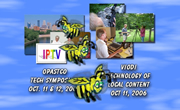
Agenda Set for Technology Local Content – Tut & Entone to Sponsor The final agenda has been set for the Technology of Local Content Workshop and new speakers include Harry Kline and Matt Sperlin, Producer and Director of Photography for HBC Productions, respectively. HBC Productions is the local content creation arm of HBC, the Minnesota independent telephone company that is doing some amazing productions. Also, Roger Bindl is going to be showing telcos how to create community-generated animations. Viodi is also pleased to announce that Tut and
Entone are co-sponsoring this event. These two suppliers have
consistently been committed to serving the independent telcos
through thick and thin. |
ViodiTV DVD Included with Registration a $99 Value |
The demise of quality might be related to a loss of loyalty; loyalty to customers, loyalty to employees, loyalty to suppliers, loyalty to shareholders. Related to the theme of loyalty, I penned an article about the idea of vendors being “fair-weathered friends” to independent telcos. Club Viodi members can read that article by clicking here:
A friend of mine, Tom Olson, President of Olson Technologies, chimed in on the article premise at the forum board and pointed out that this lack of loyalty cuts both ways as it is difficult for suppliers to survive and continue creating quality products in a world where customers buy on cost only. You can read his comments by going to the forum board. While you are there, feel free to comment on this topic or Tom’s astute wisdom.
Phildelphia’s Wireless Initiative – An Opportunity for Comcast?
|
I felt the pain of poor quality while in Philadelphia last week. I had forgotten my USB to Ethernet adaptor (my lap-top’s Ethernet port is broken) and so I couldn’t tie into the hotel’s Internet. After a half hour of struggling to renew a day pass from a brand wireless Internet hot-spot provider located in a brand name coffee shop, I gave up and hit the pavement looking for the ubiquitous wireless that made Philadelphia famous as a pioneer in the municipal wireless world. Turns out, I could see a couple of networks that appeared to be the official Philadelphia quasi-municipal network, but I couldn’t log on. I finally had to settle for a hotel network that provided free access. Ironically, the key note speaker at NTCA’s Fall conference was Greg H. Goldman, the CEO of Wireless Philadelphia. |
|
 Surfing
for Wireless in Philadelphia
Surfing
for Wireless in PhiladelphiaWireless Philadelphia is a non-profit corporation charged with ensuring the network is rolled out and service is provided to all neighborhoods and that affordable service is provided to lower income level households (25,000 subsidized accounts at $9.95 per month will be offered) without using taxpayer dollars. As Goldman described the deal with Earthlink, the company that is building out the network, it occurred to me that really what the city of Philadelphia has done is created a third franchised provider (after Verizon and Comcast).
Although there are rules that apparently allow other ISPs to access the network in a non-discriminatory fashion, it’s not clear what that means. For instance, could Comcast use the wireless network to offer a wireless VoIP service to complement the triple play that runs over their network? With IMS (Internet Multimedia System), a seamless quadruple play of voice, video, Internet and wireless could be created utilizing Comcast’s existing network, in conjunction with city-wide WiFi network. Another question I didn’t get a chance to ask is what level of exclusivity is there between Earthlink and Philadelphia. For instance, could the incumbents, Verizon and/or Comcast, build competing WiFi or WiMAX networks using city property the way Earthlink is doing?
Should Rules for Rural Wireless Auctions Be Different
OPASTCO makes a strong argument in their filings with the FCC that the rules for spectrum auctions need to be different for rural areas. The way the rules are set up today, the blocks of spectrum are geographically so large that the winners are purchasing them for the urban areas and often ignore the rural areas. OPASTCO proposes smaller geographic blocks to solve this problem, as well as provisions whereby winning bidders would lose the rights to spectrum if they did not build it out in a reasonable period of time. To read their comments to the FCC, click here.
Will the Real “Mobile WiMAX” Please Stand Up! - by Alan J. Weissberger
When will "Mobile WiMAX" actually be used to provide service to mobile users? Perhaps, later then you think. What WiMAX applications do operators favor in the near term?Alan Weissberger recently attended a press briefing and seminar on the impact of the various approaches for broadband wireless data. He has some useful analysis on the initial applications for “Mobile WiMAX” and some of the potential competing technologies it faces, including Fixed WiMAX and 3G data technologies. We note with interest that Intel has started to hedge its WiMAX bets by planning to offer HSPDA technology designed by Nokia. Click here to read this article.
Weissberger also penned an interesting piece for the WCA on their view of what some of the current future gadgets and gizmos will be. It can be found at
http://www.wca.org/year2006/summary/WCA-091906.pdf
He writes of a low-cost mesh WiFi networking solution, a VoIP over WiFi system that features phone badges and an attendent-free, wireless parking lot.
Apple’s iTV or Google TV – A Trojan Horse for Something Bigger?
Some of the gadgets Weissberger discussed could mesh with Apple’s announcement last month of their forthcoming iTV product. Conventional wisdom has it that this product will really be a sophisticated Digital Video Recorder with networking features and access to all of the commercially available iPOD content. Click here to read this article in which I speculate what this box might really be and, if it isn’t, how some company like Google or Yahoo! might be able to deliver a similar offering that could be a Microsoft killer.
NTCA Fall Conference & Key Employee Conference Take-Aways
The best thing about the NTCA conferences is the caliber of attendees that are drawn to these events. The Fall Conference, which was last week in Philadelphia, draws Directors and General Managers. It is really interesting speaking to the Directors of the cooperatives, as they bring a different, more practical perspective to the telecom industry as they are also the customers of the service in their roles as farmers, bankers, teachers and other community leaders. I was fortunate as I was picked to speak about my favorite topic, local content. NTCA’s Key Employee Conference, held at the beginning of this week, combines multiple certificate courses intended for independent telco employees to receive training and education on a diverse range of management topics from leadership to strategic planning to team building. I was fortunate to recording this inaugural event for NTCA. Attendees represented a broad cross-section of telco company employees from accounting to engineering to marketing to general management. |
Sponsors Highlight A new feature for the sponsors of the Viodi View is Sponsor’s Highlight. This is a trigger to let you know that there is more to this story and that Viodi will provide the sponsor with important tidbits not reported on in the main issue. Companies that have sponsored a Viodi event or the Viodi View within the last three months are eligible for these updates. To inquire about sponsorship opportunities, contact us at sponsor at viodi.com. |
Barry Woolf, President of Training Works, who provided an excellent review of coaching, team building and leadership, correctly characterized this sort of event as R & R – Review and Reflection. He emphasized that he really wasn’t telling the attendees anything they didn’t already know, but that the structure of the event was ideal for thinking about the way they currently do things and ways they might improve things.
Probably the most value of these conferences is the chance to talk and interact with independent telcos. One of the things I have learned over the past few weeks from talking to independent telcos in meetings like this is that the commercial rollout of MPEG-4, at least for independent telcos, is looking like Q2 of 2007. Lack of set-tops and interoperability seem to be IPTV’s current Achilles heel. For many, the need for MPEG-4 will be moot, as a surprising number are aggressively deploying all fiber architectures and some will be 100% fiber to the home within two or three years.
A Peer to Peer Conference with Peers
Peer to peer will become more and more important moving forward as the increased bandwidth due to fiber to the home and other high speed technologies becomes more widely deployed. As such, we are just beginning to see the impact of peer to peer on the rest of the network, as it truly allows intelligence and storage to sit at the edge of the network. The Distributed Computing Industry Association has done a great job of pulling the P2P industry together in terms of policy, business and technology standpoint. The DCIA is holding their first annual P2P Media Summit on October 23rd to 26th in Santa Monica in conjunction with Digital Hollywood.
I was saddened to hear of Wendell Bailey’s passing from cancer last week. Although, I never had a chance to talk to him at any length, I felt like I knew him through his monthly columns in CED. Back in the1980s, information was much more precious and I always enjoyed reading columns from Wendell, Chris Bowick’s and Roger Brown as they informed, taught and entertained. Bailey was an important part of cable’s maturation of an industry. He will be missed.
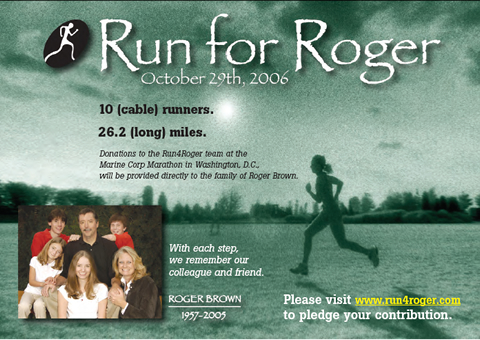
Another person who is sorely missed in the industry is Roger Brown. At various times, Roger held editing and publishing roles at CED. More importantly than his professional roles was his friendship to me and so many others in the industry, as well as his deep love for his family. One of our mutual friends, Leslie Ellis, has dedicated her marathon run this year to Roger and is raising money for the education fund for Roger’s four kids. To help Leslie, please click here to go to the web site that was put together for this effort.
By the way, Leslie has a great
article on some of the new gadgets she saw at the CEDIA
show in Denver last month. I especially love her description of the gold-leafed
flat-panel television that transforms into a mirror.
Oops – correction to last issue
In the last newsletter, Rob Pullen of Tellabs was listed as TIA’s incoming president. He is actually the incoming chairman for TIA, not president. Grant Seiffert, currently Executive Vice President of TIA is the incoming president.
I might have met someone who was crazy while standing in the security line at the Philadelphia airport a few weeks ago. The security line was unusually long and, for a change, I slowed down a bit and actually had a conversation with a stranger. Turns out the somewhat earthy person standing next to me was a physical therapist from Alaska. She explained how she lived in the relatively remote Denali Park (home to Mount McKinley, the tallest peak in North America).
That was only part of the story, however, as she was traveling to her southern winter home where she spends four months of the year. Her “winter home”, as it turns out, is in Antarctica. She spends four months plying her physical therapist trade at the population 1,200 American research base. Being this was the first person I had ever met who actually had visited, much less lived at the bottom of the earth, I was extremely interested to hear her stories of life in this frozen land.
As it turns out, there must be a lot of aches and pains among research scientists, as she said she tends to know just about everyone in this isolated community. Part of this may have to do with the community events, such as movie night, in which they partake. She definitely painted a picture of a pace of life that was much slower than the one we find in the permanently inhabited continents.
Oh yeah, about her mental illness, she claimed she was bi-polar (drum roll please).
Viodi View Subscribe


Technology of Local
Content Workshop
Oct. 11, 2006

OPASTCO's 4th Annual Technical Symposium
Minneapolis, MN.
 ViodiTV DVD More Info

The Video Business Case for Independent Telcos – The Report
Viodi’s report, Video Business Case provides results to a survey of independent telcos and their business case for video. Most of the telcos that responded to the survey have figured out a way to deploy video services. This survey provides insight from the independent telcos as well as several of their Engineering firms.