
Viodi View Menu
| Current Issue |
| Previous
Issue
|
| Viodi
View Subscribe |
| Viodi Forums |
| Multimedia
Search |
| Viodi Workshops |
| Industry |
| About Viodi |
Interested in Sponsoring the Viodi View? Send an email to: [email protected]
Please forward this free publication to anyone you know who is involved in some way with independent telephone companies.
Mission of the Viodi View:
In this on-line publication, we share our analysis, opinions and direction on the interactive television news and views that we believe will be of interest and use to our friends associated directly or indirectly with independent telephone companies. For more information as to the various ways Viodi works with independent telephone companies, please go to http://www.viodi.com/alliance/
Disclaimer:
The Viodi View [Viodi, LLC] and its associates used their best efforts in collecting and preparing the information published herein. However, the Viodi View [Viodi, LLC] does not assume, and hereby disclaims, any and all liability for any loss or damage caused by errors or omissions, whether such errors or omissions resulted from negligence, accident, or other causes.
All displayed trademarks, logos and service marks are
the property of their respective owners. © 2005Viodi,
LLC. All Rights Reserved.
5255 Stevens Creek, #127 Santa Clara, CA 95051
Viodi View Newsletter - January 25th, 2006

Click here to learn
more about Viodi's Local Content Workshop
700 MHz WiMAX & More
By Alan J Weissberger, [email protected]
[Editor's Note: If you would like to see a follow up article in Viodi on the WCA Symposium, please inform the author of what you are interested in. The author is actively seeking research related and technology assessment work in BWA. He is willing to consider a variety of projects and is available on relatively short notice.]
The 12th WCA International Symposium was chock full of
keen insights into the current state and future direction of broadband
wireless access (BWA) - both fixed and mobile varieties. Most
of the WCA sessions focused on WiMAX related technologies, but there were
sessions on municipal WiFi, spectrum allocation and an excellent overview
of the Internet Multimedia Subsystem (IMS).
Here are some quick highlights -with more to follow in the next issue
of Viodi (dependent on reader feedback as to what you'd like to see):
- Intel Capital is investing heavily in wireless broadband, especially in developing countries. They say that IEEE 802.16 standardization will be crucial to WiMAX adoption, as regulators have acknowledged the role and relevance of standards based technologies. Hence, they take a more favorable view of commercial deployment. VoIP (cheap voice services) and broadband universal access (wireless technology levels the playing field for rural areas and developing nations) are the key drivers for WiMAX. The real opportunity will be when WiMAX mobile (IEEE 802.16e) converges with 3G cellular to provide higher speed multimedia and video services (including broadcast TV to notebooks and hand held gadgets).
- Several carriers have and continue to deploy pre-standard (IEEE 802.16d-2004) fixed WiMAX technologies to deliver high speed Internet access and VoIP. These services are primarily for residential and small business customers.
- It seems that BWA carriers have little incentive to switch to standardized fixed WiMAX, which may have missed its market window. Note that IEEE 802.16e standard has been approved and it will support both fixed and mobile applications. It is not at all compatible with fixed WiMAX as it uses a different PHY and different radios. It will be interesting to see if Clearwire migrates their current fixed BWA deployments (from their equipment subsidiary NextNet) to fixed WiMAX.
- Tower Stream has deployed pre-WiMAX fixed technology in six large US cities and offers enterprise customers cost effective T1 replacement. 80% of their customers use the service as their primary communications pipe; others use it for disaster recovery or load balancing. AT&T has trialed the technology and is also considering deploying it to enterprise customers as unchannelized T1s. Applications include: fast Internet access, VPN with SLA guarantees, and VoIP.
- Most pre WiMAX deployments (outside the US) are in the 3.5GHz band. The 2.3 - 2.5GHz as well as the 5.8GHz band looks promising for US deployment. Sprint-Nextel and Bell South own much of the spectrum in the former band. 700MHz may be suitable for greenfield deployments in rural areas (more on this in the next issue, if there is sufficient request for coverage).
- US government wants to encourage BWA and has ambitious plans to make 700MHz available in the coming years for network operators.
- Almost all the first tier network equipment manufacturers are betting on IEEE 802.16e and are not developing fixed WiMAX products are are OEM'g them from start-up vendors. This gives mobile WiMAX momentum and solid support. Those vendors include: Alcatel, Samsung, Motorola, Marconi, and Nortel.
- IEEE 802.16e may offer substantially better performance, QOS, and reliability then the 3G data technologies (EVDO, HSDPA) and Qualcomm's Media Flow network (video transport to hand sets/ gadgets)
- Expect to see IEEE 802.16e technology in notebooks in late 2007- early 2008 and in hand sets in 2009. The positioning is as a data/ video overlay or separate network that offers better performance and SLAs.
- Alcatel believes that mobile WiMAX can deliver a combination of unicast video (IPTV) and broadcast video to a handset or notebook. Those services could be tied in with others (gaming, Internet access, VoIP, etc) to create a very compelling value proposition for the customer. There is insufficient bandwidth (mobile WiMAX) to deliver high quality video to a digital set top box, according to Alcatel.
- Roaming and VoIP <-->cellular voice conversion will be a huge issue for WiMAX mobile in cell phones. Dual mode phones may be one solution, if the cost is reasonable (contemporary dual mode - VoIP/WiFi + cell phones - have not sold well).
- Spectrum convergence is another key barrier to widescale deployment of mobile WiMAX. If manufacturers have to build different CPE for each of the multiple frequencies used in different countries, they may never be able to realize the economies of scale to drive the CPE cost down (generally <$100 is a reasonable target to stimulate a mass market). In addition, frequency conversion (as well as VoIP to cellular voice conversion) will make mobile WiMAX more expensive for the consumer.
- The Internet Multimedia Subsystem (IMS) will play a key role in fixed- mobile convergence for multimedia and voice supplementary services.
Viodi View Subscribe

Content Options?
Learn About Some New Ones

Viodi's
Content Pavilion
at TelecomNEXT

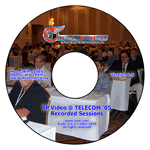
IP Video
Hear and See What You Missed
The TELECOM 05 CD is a great gift
for that hard to buy for telecom person. Call Sean Sullivan at 202 326
7260 to purchase or send an email to
[email protected].