|
by Ken Pyle ([email protected]), Viodi, LLC |
March 2nd, 2004 Issue |
|||
| Note: This is the approximate transcript from Ken Pyle's portion of the February 26th, USTA Webinar. I am giving this presentation with mixed feelings, as I am a last minute substitute for Geoff Burke of the Video Catalyst Group. I was very much looking forward to hearing Geoff give his insight into independent telcos and their forays into adding video services as part of their efforts to create bundled service offerings. Geoff has been involved with and assisted over 70 telcos that have successfully transitioned into “full service providers”. The structure and the discipline,, coupled Geoff’s real world experience, is extremely valuable to telcos entering new businesses. The good news is that Geoff has an excellent excuse as to his absence. His wife’s water broke yesterday, about a week early, and he is now the proud papa of a brand new baby girl. Please join me in wishing Geoff and his family our congratulations on this mid-winter blessing. So, I will do my best to fill his big shoes. The first thing you will note is that I purposely did not put the term, triple play or IP, in the title of this presentation. For one, thing, the metaphor, triple play, is somewhat limiting, as it does nothing to describe other services that could be added to a service providers’ package. Also, as my friend Roger Bindl is quick to point out, in baseball, triple play means the inning is over. And really, I would contend that the ballgame is just beginning. Additionally, it is imperative not to get hung up on technology. One of things I appreciate about Geoff is that he reminds me that technology is just one part of a product picture. Soft attributes like customer service and reliability are just as important. So, I will try to use the term, “Bundled Service Offerings” [maybe this could be a new acronym “Be SO”, as in this hot new product “Be So” cool] to describe the direction in which independent telcos are moving. How I Spent the Past Year…. The past year has been like a crash course MBA as to what independent telcos are doing with regards to service bundling. In that time, I have produced three conferences and workshops. One of the nifty things, at least from my perspective is that the independent telcos helped me shape the agenda for these conferences. This has helped me learn some of their concerns. I have also had the privilege of producing CD-ROMs that feature conference audio synchronized and indexed to the respective speakers’ presentations. As I am the editor of this content, I get to listen to it over and over and over. Amazingly, some of it even sinks in to my thick skull. I have done two national tours. Last summer, I went to four cities with a major telco trade association and visited with over 70 telcos. I just completed the second stop in an 11 city tour, where I am fortunate enough to lead a track on content and market, as well as produce a show regarding local content in several of those cities. Lastly, twice a month, I publish a newsletter that goes out to over 1,400 people that directly work for telcos of some form. This is a great interactive channel that gives me another opportunity to learn from my telco friends. So, the above outlets have given a great deal of information, which I will now try to distill into the few overheads that follow. The Market Rules: I have been starting off the marketing and content workshop I have been facilitating, by leading the assembled marketing folks in a chant that suggests, “Marketing Rules”. We normally yell it loud enough that the engineers in the adjacent room become somewhat annoyed. But, it is true. In any competitive industry, the survivors listen to and anticipate what the market requires. Of course, this is not an easy task and it is one that is never-ending.
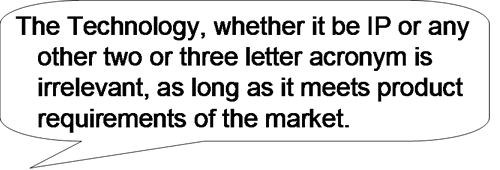
Product Management, must drive the PROCESS such that Engineering can design and operations can implement a system that meets the customer requirements, as defined by Product Management. This sort of statement is pretty much a given in product marketing circles. To many telcos, who are shifting from a monopoly position, this is a new way of thinking. Again, it is a given with competitive industries, that a Product Management function is necessary to define the product requirements in such a way that the customer needs, both present and future are met, while balancing the reality of the ever limited resources of all parts of the organization, including Engineering, Sales,and Marketing, Customer Service, Operations and, how could I forget, finance. One of the biggest challenges is to understand today’s customer requirements, while being able to anticipate tomorrow’s needs. This is a big challenge as the target is always moving, thanks to competition and technology that is constantly improving and evolving. In a word, Product Management is hard. To many independent telcos, the shift to a market driven organization is difficult. It requires a Product Management function that is able reconcile the hard and soft product attributes, such that the resulting “whole” product plays to a particular telcos’ strengths, while providing an offering that is compelling to their targeted market segment. For some, this is a struggle, as, in many ways, it is easier to deal with technology. Fortunately, most of these independent telcos have a very good feel of their market. Many help put a little structure around their good instincts by hiring from their current or potential competition. Many go outside the industry to find marketing talent. I know one telco that hired a marketing director from Pepsi, while another hired from Avery, the label people. Many hire consultants, like Geoff Burke, to help implement a Product Management process and train their organization to embrace a new approach. What continually impresses me is how quickly these independent telcos can get up to speed on a business that is, in many ways, very different than their base business. I have seen many telcos start from scratch and, within a year or two, become the dominant video provider within and outside their traditional telephone exchange areas. This is because they inherently understand their community, as they have deep roots in the areas they serve. They understand that it is still important to quantify their knowledge with objective data. Thus, they do commission market surveys, focus groups and, maybe most importantly, arrange “town meetings” to hear first had the wants and needs of their customers. Some Givens: A couple of the high-level givens, heard repeatedly from telcos, are the following:
As you can probably tell, I am very passionate about this market and look forward to learning from the next few presenters how IP video can help an independent telco meet the current and future needs of their customers. To view the complete archived webinar, please click here. All displayed trademarks, logos and service marks are the property of their respective owners. © 2004, Viodi, LLC. All Rights Reserved | ||||