| Bits and Bites...Home Multimedia.. by Ken Pyle |
November 18th, 2003 Issue |
||||
| The following are some interesting tidbits picked up from the Home MultiMedia Experience. For the most part these are presented in their raw form. A representative from Digital 5 suggested that Digital Media Adaptors will be less than $100 by next Christmas. They should know as they supply the “middleware” that is used in the networked Gateway DVD player, as well as the Zinwell Digital Media Adaptor set-top box. Digital 5 suggested that the Zinwell DMA can be purchased for $129 today. This is pretty revolutionary, in terms of where IPTV is going. Note, in the Consumer Electronics world, middleware only refers to the software on the set-top box and not the back-office software. There was a bit of shoot out between different ways to use wiring within the homes to provide high-speed networking within the homes. Not clear which of these, if any, will be the ultimate winner, but they are all probably worth watching as they provide potential solutions to ease the independent telcos home networking challenges. Home PNA3, with rates of 80 to 90 Megabits per second over existing telephone lines, is preparing to ship. Entropic, with investors like Comcast and Motorola, is claiming to be able to support 280 Mb/s over in-home coaxial networks. Peter Kempf talked about the newest standard for high-speed data over home electric outlets, the HomePlug AV. This 180 to 200 Megabit per second solution will be on display at CES. While all the wired standards are being developed, there are plasmas displays, as well as other televisions, that are being developed which will have integrated wireless connectivity. Except for the electrical connection, there would be no other cables to connect one of these new wireless televisions (wait, that’s what they used to be when I was a kid). The HomePlug folks suggest that their HomePlug AV standard could accomplish this same goal of eliminating unsightly cables. Scientific Atlanta’s business is being driven by HDTV and DVRs. They have networked DVRS, so they can serve other STBs in other rooms. DVI (video), 1394a (for peripheral) and DHTP (firewire Std) are standards that they see as important for video. 1394b demo increases bandwidth to 100 Mb/s and extends distance to 100 Meters between devices. Working 802.11 and 802.15c to provide 1394 firewire, or maybe they should they should call it firewireless (my joke). Running 1394 over CAT-5 is a new standard. 1394a has been mandated by the FCC for set-top to television standards. Next big driver for home networking demand will be HDTV One of the speakers made the statement that in the United States every year, 11% of houses are effectively rewired with respect to their telecommunications infrastructure. Unfortunately, I didn’t have the chance to learn more about the details of this factoid. Installers hate DVI, according to Tricia Parks. This is an important point for telcos that will be helping consumers with their overall television experience. Parks has installers as part of their consumer focus group, so they probably as knowledgeable as anyone in this matter. DVI allows HDTV to synch up with STB from scan rate, screen size perspective, etc. Seems like most of the convergence is IP using Universal Plug and Play (UPnP). UPnP is a Microsoft-pushed standard for interoperability between devices, http://www.upnp.org/. Important question of why can’t we have only one remote control was asked. Universal Electronics is looking into applications where the remote control is software in a PDA and/or the remote control talks directly to Pat Hayes to databases. A representative from the Internet Home Alliance suggested that there are opportunities to add home automation features into the remote control. A real interesting company that was represented on one of the panels is AMX. They cater to high-end customers who are early adopters. Clearly these are not mainstream customers, but the applications are signs of things to come for the industry. They have approximately 100,000 installations. AMX suggests that consumers want choice. To give them choice, they are selling things like dockable wireless appliances that go in the kitchen. They suggested that users can “scan the can” upon discarding a used food packages and that their system could effectively create a “list”. They also install high end home theatres and sound systems. What was impressive is the 7.2 terabyte redundant server they sell for consumer application. John Barrett of Parks Associates suggesting that the phone data networks, that using the phone as a narrowband return for authentication. The data might actually be transferred via another network, such as Wi-Fi. In fact, Peter Lowten reported [September Issue of the Viodi View] of a European set-top that integrates GPRS as a return path. All displayed trademarks, logos and service marks are the property of their respective owners. © 2003 Viodi, LLC. All Rights Reserved |
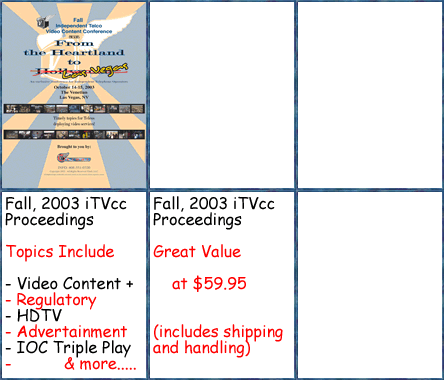
NOTE: THE PROCEEDINGS ARE ONLY $49.95 for Club.Viodi Members Click
Here for
Note, Viodi's standard terms and conditions apply. 
|
||||