| The
following are some observations that I thought should be made in the
private confines of the club.viodi.com forum. They are not organized
in any sort of priority.
- Patrick Carlsson of Gerbsman Partners, a venture fund, suggested
that WiMAX standards could be used to deliver
cable television services. WiMAX offers the potential of
being a low-cost way to serve high-cost areas or an alternative way
to implement a triple-play overbuild.
- The use of UWB (Ultra Wide Band) promises to free consumers from
the spaghetti nest of wires required to interconnect home stereo and
televisions. It was suggested that this could be a disruptive technology,
even if it is only used for its initial application of high-speed
(e.g. 100 Mb/s min.) interconnection of existing and new CPE. UWB
could make any home broadband-capable, with virtually
no rewiring. Products are expected by next year. If the FCC approves
higher power levels, then this technology could be very disruptive
as it could find its way into the access network.
- Need to watch municipalities as they are getting
agressive about WiFi. Today, there are ten municipalities
that are providing service through over 1,000 WiFi access points.
This number is expected to rapidly increase. Coincidentally, there
was a convention of the APPA (American Public Power Association) in
Kansas City last week. I am sure all things wireless was a hot topic.
- 802.16 (WiMAX) is big right now. If I were an independent
telco and were looking at Access Carrier Equipment, I would
certainly want to understand what their upgrade plan for the
integration of 802.16. It seems that 802.16 could be a complement
to an access carrier’s equipment. It could also be an alternative
to other forms of access as 802.16 could be used as a back-haul system,
potentially eliminating the need for a traditional copper or fiber
carrier.
- Over and over, it was said that the industry is “at
an inflection point”. This is same thing I heard last
week at the Digital Hollywood conference with regards to Digital Video
Recorders. Wow, just think of the explosion when these two inflection
points get together (wireless DVRs).
- Bernie Arnason of NTCA had a good idea
regarding 700 MHz licensed spectrum and HDTV. Since
it is his idea, you should probably contact him directly at [email protected]
to get the details.
- Similar to last week’s conference regarding DVRs, it was
stated that WiFi will be more of feature than a product.
In fact, Mike Apgar of SpeakEasy Inc. predicts that all hot spots
will be free by 2006. He, like others, is concerned that wireless
may be in the midst of a bubble. He is concerned that investors are
looking to make money off of wireless in of itself. He stated that
it is a feature that will help make other products more “sticky”.
To this point, he said that layering services over the network is
where the real value of the network will be, not WiFi itself.
- Speakeasy has a radical program where they set
their customers up as mini-wireless ISPs. They provide the “back-haul”
(a DSL line) and the billing to a consumer who buys the hot spot equipment,
does the marketing and is responsible for maintaining service. It
seems like a great strategy for Speakeasy to grow their base with
minimal capital investment. This could be a big threat to
telcos. Fortunately, for independent telcos, Speakeasy concentrates
only on the large markets.
- Rockport Telephone in Missouri has built out two
towns as a wireless CLEC. They found that a telco
needs to be creative and have relationships within the targeted overbuild
community. Backhaul bandwidth is a critical consideration in the business
plan. They found they had one competitor; a person working out of
their garage providing Wi-Fi to about 25 people, charging $30 per
month and using DSL as a back-haul solution.
- Some independent telcos are looking at providing the full triple
play over WiFi or WiMAX.
- If the operator provides the access point, then
it is much easier to prevent sharing and to ensure that the network
is secure. One operator looks at the individual bandwidth
usage to get an idea of whether someone may be sharing their
line.
- One IOC estimated the average bandwidth required per customer and
then set the peak limit per customer to 10x
the average bandwidth. Beyond the peak limit, they charge
their customers for the extra bandwidth used. They have rarely ever
charged anyone as they give the customer a warning the first month
the customer exceeds the peak limit.
- One of the panelists suggested that, today, a single access point
can handle 10 simultaneous conversations. Beyond
ten conversations, degradation can be expected.
- It was also suggested that it will be about 12 to 18 months
before a device that combines VOIP, cellular and WLAN will be a commercial
product. Maybe this not-so-future device will cook hot dogs in 45
seconds as well.
Back to Top
Back
to Main Page
All displayed trademarks, logos
and service marks are the property of their respective owners. ©
2003 Viodi,
LLC. All Rights Reserved |
|
|
NOTE: THE PROCEEDINGS
ARE ONLY $49.95
for Club.Viodi Members
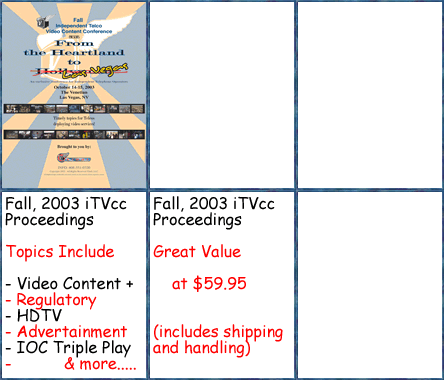
Click
Here for
Fall, iTVcc Details
Note, Viodi's standard
terms and conditions apply.

|
